Choosing the right golf ball is one of the least regarded choices that a player can ever make during a season. Frequently, golfers devote time and money in drivers, irons, wedges, and even on putters; however, they change golf balls without even knowing the extent to which the ball affects distance control, spin rates, feel, trajectory, and scoring confidence. A golf ball unites all the clubs in a bag, i.e. its properties influence the tee shots, the approach play, the performance on the greenside and the putts equally. In this ultimate vice golf balls review, the Vice Pro Plus will be reviewed in detail, including both quantifiable performance data, on-course performance, durability test, and real-life value over a long duration of evaluation.
Instead of short-term impressions or comparative impressions of the superficial, the analysis explores several practice sessions, launch monitor data, wedge tests, bunker tests, mid-iron retests, and full driver carry tests in the context of real-world playing situations. This article has a simple objective. It is also meant to convey the clarity to golfers who are contemplating to switch to the Vice Pro Plus and also give them in-depth information that they can use before making a commitment decision of buying in bulk and using seasonally.
What Is the Vice Pro Plus?
The Vice Pro Plus is a four-piece urethane-covered golf ball designed to meet the needs of those players who swing faster and those who need to have a controllable distance between long-game distance and short-game spin. Having a compression of 100, it is in the firmer category of golf ball design, which is generally of advantage to those golfers who are able to reach the maximum compression of the core at impact.
This ball, unlike the lower compression models, which are designed to be soft, is designed to give the ball the maximum ball speed with a predictable spin in and around the green. The multi-layered design is designed to provide a performance split that is active upon use: with the driver the lower spin is used to provide better carry and reduced trajectory, and with higher spin used when performing wedge shots to ensure consistent stopping power.
In this vice golf balls review the point of concern is not spread across branding comparisons but on measurable performance and consistency as the ultimate beneficiary of a product in golf are the golfers with results and findings, not the marketing lingo.
Why I Committed to Vice Pro Plus for the Entire Season?
There should be trust and technical sense when selecting a single golf ball to compete in a whole season. The change of models breaks the distance calibration, short-game feel memory, and consistency of wedge control. Ball-choice stability commonly results in scoring stability.
My average driver swing speed is between 117 and 125 miles per hour, which puts me squarely in the group that would use more compression models. Although I used the less aggressive Vice Pro before, I desired more feedback on my impacts and more responsive reaction on my controlled wedge shots. That desire of more critical response, and constant turnover consistency, eventually took me to the Pro Plus.
The other decision determinant was cost efficiency. Five dozen balls were bought which brought the price to around 2.50 per ball. This difference in pricing is significant over a complete playing season, particularly when it involves players who practice regularly or who play regularly.
This part of the vice golf balls review points to the fact that the choice was not made based on price, but on the anticipated performance in respect of swing profile and scoring objectives.
Ideal Player Profile for Vice Golf Balls Review
High compression golf balls do not do exactly the same good to all golfers. Compression is most effective in combination with an adequate swing speed and clean ball striking.
The Vice Pro Plus best fits those players who:
- produce driver swings greater than 105 miles per hour.
- Provide regular contact by irons.
- Like to have stronger impact feedback to enhance awareness of strike.
- Aggressive pin positions require strong greenside spin.
- Competitively play or pressurized demand controlled trajectory.
Although benefits of greenside spin may still be seen with moderate swing-speed players, the greatest benefit is located when the ball is fully compressed. The most visual benefits will be felt by players that inherently build up speed and solid contact patterns.
It is important to have personal swing characteristics before choosing a compression profile and this vice golf balls review supports the fact that there is a correlation in the speed of the swing and the ball design.
Vice Golf Balls Review: Internal Construction and Layer Technology Explained
The Vice Pro Plus has a construction system of four layers that is meant to isolate spin performance on various clubs. The internal core is constructed at high speeds in terms of energy transfer that is, it gives maximum ball velocity upon impact by a driver or long iron. The layers of mantle around them control the spin rate during mid-iron and approach shots, so as to avoid too much long-game spin but maintain accuracy.
The outer cast urethane cover increases impact friction with the use of wedges and short irons where grooves grab successfully and produce more RPM levels on partial and full wedge swings.
| Component | Design Feature | Performance Benefit |
| Core | High-energy speed core | Increased ball speed and distance |
| Mantle Layers | Dual mantle system | Controlled spin separation |
| Cover | Cast urethane material | Enhanced greenside control |
| Compression | 100 rating | Optimized for fast swing speeds |
| Dimple Pattern | Aerodynamic stability | Consistent flight path |
This structured layering enables distance optimization without sacrificing short-game performance, which is a hallmark of premium golf ball engineering.
Visual Design and Packaging Experience
Confidence is usually determined at the start of the round on first impressions. The new 2026 package has a sleek and minimalist look as compared to the previous loud looks. The design is minimalistic, contemporary and simple.
I chose the neon green one because it could be more visible in the cloudy weather and in heavy rough. The greater visibility on the grey skies and darker fairways allowed tracking of the ball flight much easier. Visibility benefits need not necessarily have any influence on spin or distance values but they enhance practical playability.
The alignment marking is not so overbearing and still useful, which helps to put alignment and not to overrule the shape of the ball. This is supported by the smooth finish of the paint coating that looks consistent on several sleeves. The familiarity is the starting point of confidence and the manifestation of visual clarity adds something to it.
Vice Golf Balls Review: Putting Feel, Sound, and Roll Characteristics
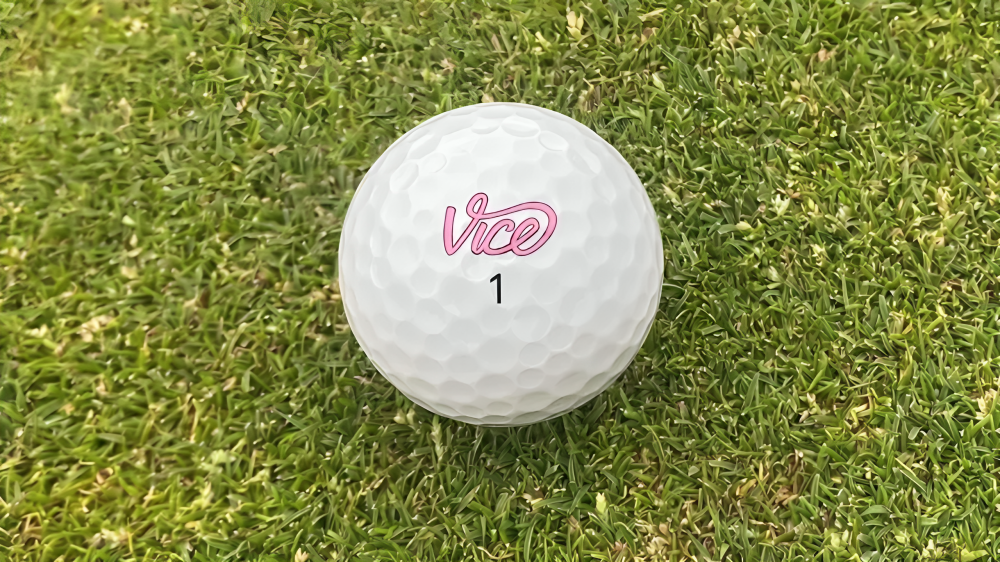
The immediate compression category variations are brought out in putting feedback. The Vice Pro Plus has a solid, distinct click when hitting, whereas the soft models have a deeper impact.
The difference was noticeable in the side-by-side test with the soft Vice Pro. The Pro Plus provided better feedback and a little faster initial roll off the face of the putter. The smoother model was dampened and to some extent cushioned.
Distance control was becoming more predictable with longer sessions. The consistency was also quite accurate, and this allowed the firmness to refine the stroke consistency and pace awareness. Some players are seeking less sharpness in their acoustics, but roll is the important issue in the end and not sound preference.
The performance of these vice golf balls review in the putting performance shows that firmness does not affect the reliability of roll.
100-Yard Wedge Testing and Spin Analysis
Short-game performance remains critical for scoring potential. Repeated 100-yard wedge shots using a 54-degree wedge produced an average spin rate of approximately 9,200 revolutions per minute.
This level of spin confirms strong stopping capability. Although earlier seasons with newer wedge grooves showed slightly higher spin readings near 9,400 RPM, the current performance remains firmly within tour-level expectations.
| Shot Category | Average Spin | Observed Behavior |
| Full 100-yard wedge | 9,200 RPM | Immediate stopping response |
| Controlled three-quarter swing | High retention | Strong first bounce check |
| Greenside chip | Consistent friction | Controlled rollout |
The ability to land approach shots with confidence and attack pin placements defines competitive ball performance, and this section of the vice golf balls review underscores that strength.
Greenside Control and Shot Stability
The testing around the green involved chips in the calm atmosphere and in a slight breeze to determine the stability. The ball exhibited the same spin response without climbing too much on the club face.
Delicate pitch shots and half swings had constant angles of friction and descent. The initial bounce did not come out unpredictably as it should when playing narrow landing fields near the pin.
Predictability in short-game also minimizes the scoring nervousness and permits aggressive decision making. Reliability in conditions of actual play was checked by stability under different conditions.
Bunker Testing and Cover Durability
Durability testing involved intentional greenside bunker shots to evaluate urethane cover resilience. Ten bunker strikes resulted in only one minor scuff, which occurred after a thin strike rather than normal contact.
| Test Scenario | Result | Conclusion |
| Greenside bunker shots | Minimal surface scuff | Strong cover resistance |
| Full wedge strikes | No tearing or peeling | Maintained structural integrity |
| Multi-round use | Surface remained intact | Long-term reliability |
The urethane cover resisted peeling and excessive marking, supporting bulk purchasing confidence and overall value.
Mid-Iron Spin Evaluation and Retesting
Initial 7-iron spin readings ranged between 5,800 and 6,000 RPM, which fell below historical averages of approximately 7,200 RPM. Investigation suggested that strike inconsistency and physical fatigue influenced early data.
After correcting swing path and restoring a natural fade pattern, retesting showed spin increasing to approximately 7,150 RPM, aligning closely with expected values.
| Metric | Retest Data |
| Club Speed | 101 mph |
| Ball Speed | 136 mph |
| Spin Rate | 7,150 RPM |
| Carry Distance | 185 yards |
The ball responded accurately once compressed properly, confirming that performance is strongly influenced by strike quality rather than design limitation.
Driver Distance, Launch, and Spin Control
Driver testing was conducted using a Cobra RadSpeed driver that was not custom fitted, ensuring realistic everyday performance rather than optimized laboratory conditions.
| Metric | Measured Result |
| Club Speed | 120 mph |
| Ball Speed | 176 mph |
| Spin Rate | 2,500 RPM |
| Carry Distance | 320 yards |
Spin remained within optimal range for high-speed players. Launch appeared penetrating and stable, even in light wind. There was no ballooning or excessive climb.
The long-game data within this vice golf balls review confirms that the Vice Pro Plus competes effectively in the premium performance segment.
Value Comparison Within Premium Market
Tour-level golf balls often exceed £4.50 per ball at retail pricing. Purchasing the Vice Pro Plus in bulk reduces cost to approximately £2.50 per ball, creating a significant difference over a full season.
| Ball Category | Approximate Cost Per Ball |
| Vice Pro Plus (Bulk Purchase) | £2.50 |
| Premium Tour Ball Equivalent | £4.50+ |
Performance remains competitive while cost stays substantially lower, making value a key advantage.
Final Thoughts on Vice Golf Balls Review
Having undergone thorough testing in putting, wedge play, iron performance, driver distance, bunker durability and full rounds on the course, the Vice Pro Plus showed consistent and predictable results. The aggressive scoring strategies were supported by spin rates. Driver launch was also stable and efficient. Sturdiness was worth massive investment.
The Vice Pro Plus is a strong competitor in 2026, to golfers who have faster swing speeds and are looking to have firm feedback, controlled spin separation, and high-quality performance at a lower price point.
This is a vice golf balls review that substantiates that there is room to have both performance and value when their construction is attuned with both the swing profile and scoring requirements.
Also Read About :- Longest Drive in Golf 2026: Tour Distance Leaders