The following is our entire pickleball rules doubles guide with a single objective: clarity in the court. Doubles pickleball rewards coordination, awareness and rule knowledge. Thus, the knowledge of the game framework helps the teams to move and not to act on the spur of the moment. Besides, rules are kept in mind and decision-making becomes natural during rallies.
This manual is centered on accuracy, simplicity and match-readiness. The direction of doubles play is explained in a straightforward way, with language being simple and practical. Consequently, players are able to concentrate on performance instead of being confused. Regardless of whether you play as a recreational player or a competitive player, the knowledge of the rules in their organized form will alter the game experience instantly.
Rules of Pickleball Doubles and Court Awareness
The rules of pickleball doubles rely on the understanding of the court. The sizes of the court are the same in singles and doubles but the arrangement of the players varies greatly. Most of the strategic exchanges are governed by the non-volley zone, which is also known as the kitchen. Players are allowed to go to the kitchen at will, but not to volley when inside the kitchen.
Also, the players should not step into the kitchen when the ball gets in contact with the volley because of momentum. This is a regulation that safeguards equitability at the net. As a result, it leads to the necessity of disciplined footwork. Teams that respect this area have longer rallies and strategies are cleaner.
Pickleball Rules Doubles: Serving Mechanics
Serving defines rhythm and therefore serving rules play a pivotal role when the pickleball rules are in doubles mode.
- The serve must be hit diagonally and land outside the kitchen area.
- The ball has to clear the non-volley line before bouncing.
- Players must use an underhand motion when serving.
- Contact with the ball should occur below the waistline.
- At least one foot must remain behind the baseline during the serve.
- Only one serve attempt is allowed per point.
Consequently, serving is a skill that integrates a cool mechanic with proper targeting.
Pickleball Rules Doubles : Starting the Game Correctly
When the play starts in a match ruled by the pickleball doubles rules, the score starts at 0 -0 2. This restriction allows equity, as this keeps the opening team to a single server. Once that initial fault occurs, service is given to the other team, which then gets two service turns.
Early-game patience is relevant due to this construction. Rally consistency, and not aggressive risk, should be the priority of teams. In the long term, this opening sequence creates a balance in the competitive advantage.
Understanding the Three-Number Scoring System
Scoring clarity is what is between a confident and a hesitant team in pickleball rules doubles.
| Element | Description |
| Score Format | Announced in three parts: serving team score, receiving team score, server number |
| Point Scoring | Only the serving team can score points |
| Tactical Impact | Encourages strategic and careful serving |
| Example Score | 7–4–1 shows the server, current scores, and serving position |
| Game Ending Rule | Most games end at 11 points with a minimum two-point lead |
This structure rewards steady execution rather than reckless play.
The Double-Bounce Rule and Rally Control
Every rally is formed under the pickleball doubles rules in the form of the double-bounce rule. The receiving team has to allow the ball to bounce off once the serve has been received. The serving crew should also be given a bounce back by them. Volleys can start only when these two bounces are done.
This regulation slows the speed of opening and facilitates the plan. As a result, teams are able to spend time in the right position before the ball is served before the start of net play. Owing to this rule, speed is not usually rewarded as much as patience.
Pickleball Rules Doubles: Serving Rotation and Side-Outs
Picking up rotation is an essential part of pickleball doubles rules. The teams are given two serves each time they are on the ball. The right-side player is turned into Server 1. Server 2 comes into action after an error. After the fault of both players, a side-out ensues.
Notably, the receiving team does not change until they receive the serve once more. This is a rule that provides equity and order during the game. Thus, the knowledge of server position will be avoided in confusion and redundant faults.
Pickleball Rules Doubles and Player Positioning
Success is improved when the rules of pickleball doubles are correctly positioned. The serving team usually remains behind until the requirement of the double bounce is met. In the meantime, the receiver partner tends to go towards the kitchen line once more after serving.
Teams must move together. Eliminating mistakes through the center of the court protection and eliminating redundancy through communication. Also, fatigue and quality of shots during long matches decrease due to disciplined positioning.
Common Faults Every Doubles Team Should Avoid
Fault awareness helps to play smarter in pickleball rules doubles. Errors such as stepping into the kitchen when the volley is in progress, serving the net, failing to take the diagonal or volleying prior to the bouncing of the ball are often made.
In addition to this, players should not forget that there are no longer lets. In case the serve hits the net and lands in a legal position, the play continues. The knowledge of such information will save one from losing points unnecessarily and establish consistency.
Rules of Pickleball Doubles and Kitchen Discipline
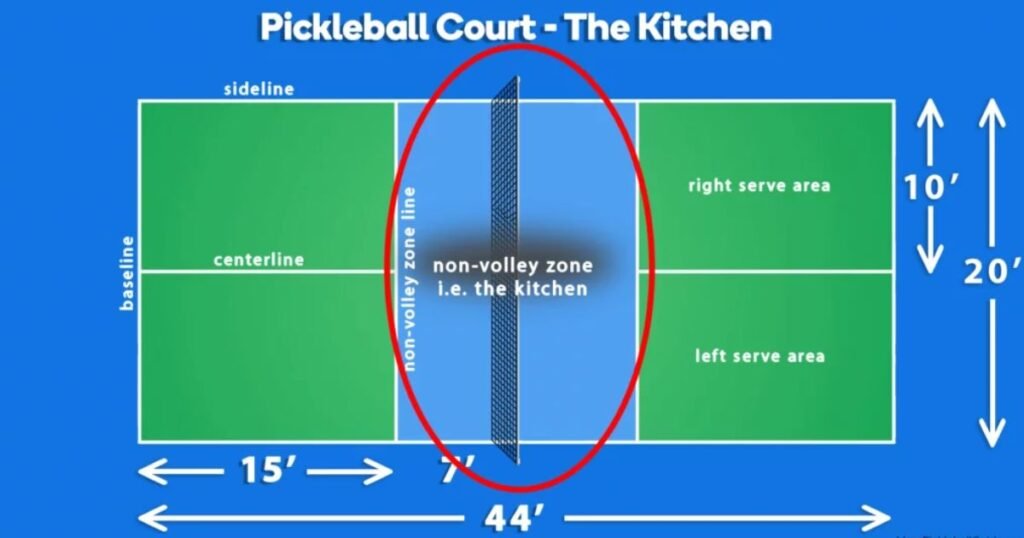
Kitchen discipline characterizes high levels of knowing the rules of pickleball doubles.
- Players may stand in the kitchen area when the ball has bounced.
- Volleys must be hit with both feet completely outside the kitchen.
- A fault occurs if a player steps into the kitchen after volleying the ball.
- Even accidental momentum carries count as violations.
- Proper footwork plays a crucial role in avoiding faults.
- Respecting kitchen boundaries helps maintain balance and fair play.
In the long run, this field turns into more net trades and extended rallies.
Equipment and Comfort for Doubles Play
When playing pickleball by rule, the comfort improves the performance. Lightweight paddles are used to enhance the speed of reaction, whereas the footwear encourages the lateral movement. Costumes must be able to permit free movement and ventilation.
Reaction time is also enhanced spontaneously when the players feel comfortable. Consequently, the execution of rules becomes easier, particularly when the rallies take long durations. Machines do not substitute expertise but favor uniformity.
Rules of Pickleball Doubles in Competitive Scenarios
The rules of pickleball doubles are enhanced by competitive games. Teams are under pressure to announce scores in a clear fashion, respect fault calls and uphold positioning discipline.
- Emotional control is also a factor, as in most cases, hurried decisions lead to breaking of rules.
- In addition, errors are minimized by the regular interaction between the partners.
When faced with pressure, teams that remain calm tend to perform rules better and have strategic control.
Strategic Awareness Built on Rule Mastery
The mastery of rules enhances the strategic thinking in pickleball doubles rules. Shot selection is better when the players are aware of which actions are still legal. Drinks take the place of dangerous impulses and position that of strength.
Consequently, the knowledge of rules gets a competitive advantage. Teams that have absorbed teams respond without hesitation as opposed to teams that are reactive.
Quick Reference for Pickleball Rules Doubles
| Area | Key Rule |
| Serve | Underhand, diagonal, one attempt |
| Scoring | Three-number system |
| Kitchen | No volley inside zone |
| Double Bounce | Mandatory on serve and return |
| Rotation | Two servers per side-out |
| Game End | 11 points, win by two |
This table reinforces essential structure without complexity.
Final Thoughts on Pickleball Rules Doubles
Mastering pickleball rules doubles transforms how the game feels on court. Once serving, scoring, positioning, and kitchen discipline become second nature, doubles play becomes faster, smarter, and far more enjoyable. Teams move with purpose, communicate clearly, and execute strategies confidently.
Understanding the rules of Pickleball Rules Doubles does not require memorization alone. Instead, repeated application builds instinctive awareness. With consistent play and rule clarity, doubles pickleball becomes both competitive and rewarding.