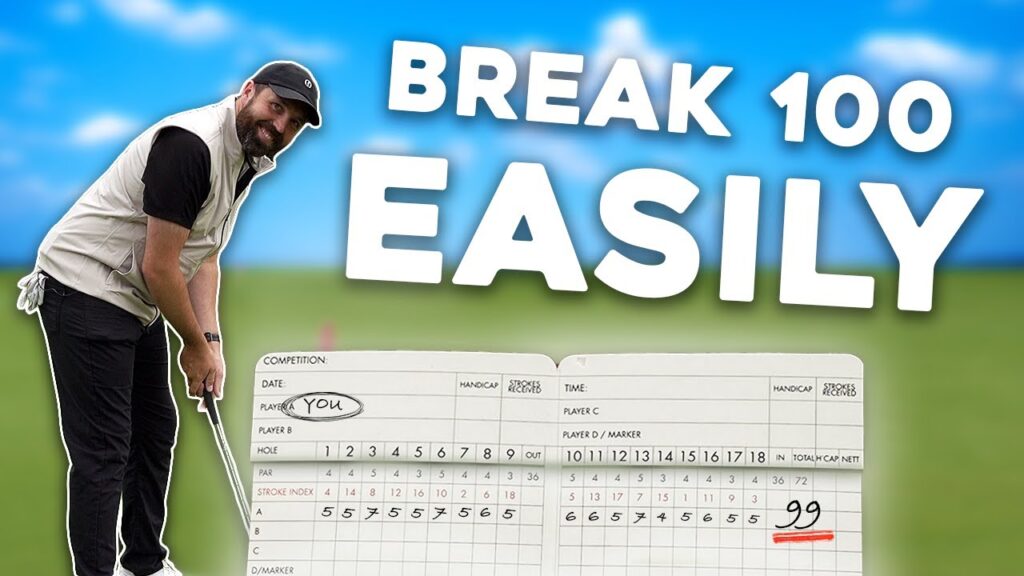
If you’ve spent months trying to lower your golf scores but still find yourself writing down numbers above 100, you’re far from alone. One of the most common goals among beginner and high-handicap golfers is learning how to break 100 in golf. It represents a major milestone because it shows that you’re no longer just hitting golf shots—you’re starting to manage the course, avoid costly mistakes, and play smarter golf.
The good news is that breaking 100 doesn’t require a perfect swing, expensive clubs, or years of experience. Many golfers believe they need to hit every fairway, reach greens in regulation, and make several pars per round. In reality, the path to shooting in the 90s is much simpler. It comes down to reducing mistakes, avoiding penalty strokes, improving your short game, and making better decisions throughout the round.
This guide will show you exactly how to break 100 in golf consistently, using practical strategies that work for real golfers.
What Does Breaking 100 in Golf Actually Mean?
Before focusing on techniques and strategies, it’s important to understand the numbers involved. On a standard par-72 golf course, shooting 99 means you’re averaging approximately 5.5 strokes per hole.
That means you don’t need to make birdies. You don’t even need to make many pars. In fact, many golfers break 100 while recording mostly bogeys and double bogeys throughout the round.
The biggest mistake golfers make is believing that great golf is required to shoot under 100. The reality is that eliminating disaster holes matters far more than creating spectacular ones. A golfer who avoids triples and penalty strokes will almost always outperform a golfer who makes a few pars but also records several sevens, eights, and nines.
Key Benchmarks Needed to Break 100
The following table shows realistic performance targets that typically lead to scores below 100.
| Statistic | Target Goal |
| Fairways Hit | 4–6 per round |
| Greens in Regulation | 1–3 per round |
| Putts Per Round | 36 or fewer |
| Three-Putts | 4 or fewer |
| Penalty Strokes | 2 or fewer |
| Triple Bogeys or Worse | 0–2 maximum |
| Average Score Per Hole | 5.5 or less |
Notice how forgiving these numbers are. You do not need tour-level performance. You simply need consistency and smart decision-making.
Stop Chasing Par and Start Playing Smart
One of the fastest ways to improve your scoring is to stop obsessing over par. Many beginners stand on a par-4 expecting to make a four, and when things don’t go perfectly, they start forcing shots and creating unnecessary risks.
Instead, create a “personal par” system. Think of par-3 holes as par-5s, par-4 holes as par-6s, and par-5 holes as par-7s. This mindset removes pressure and encourages smarter golf. Suddenly, laying up becomes acceptable, taking an extra club feels normal, and avoiding trouble becomes the priority.
When you stop trying to force pars and focus on avoiding big numbers, your score naturally starts moving toward the 90s.
Why the Driver Isn’t Always Your Best Friend
Many golfers trying to learn how to break 100 in golf lose more shots with the driver than any other club in their bag.
While hitting a long drive feels great, distance means very little if the ball ends up out of bounds, in a hazard, or deep in the trees. Most beginners only need a ball in play off the tee. A 180-yard shot in the fairway is almost always better than a 240-yard shot in trouble.
On tight holes, consider using:
- Hybrid clubs
- Fairway woods
- Long irons
- Utility clubs
The objective is simple: keep the ball in play. Golf becomes much easier when every hole starts from the fairway instead of recovery mode.
Eliminate Triple Bogeys
Perhaps the most powerful strategy for golfers looking to break 100 is adopting the “No Triple Bogey Rule.”
Let’s look at the math.
A golfer who makes double bogey on every hole of a par-72 course shoots 108. That’s not great, but it’s much closer to 100 than most people realize.
Now imagine reducing just a handful of those doubles while completely eliminating triple bogeys and worse. Suddenly you’re approaching the mid-to-high 90s.
Whenever you find yourself in trouble during a hole, stop trying to hit miracle shots. Accept the situation, advance the ball safely, and focus on limiting damage. The smartest golfers understand that saving a double bogey is often just as valuable as making a par somewhere else.
Approach Shots: Aim for the Center of the Green
One of the simplest course-management tips is also one of the most effective.
Never aim directly at the flag.
Most amateur golfers miss left, right, short, or long far more often than they realize. When the flag is tucked near a bunker, water hazard, or edge of the green, aiming directly at it creates unnecessary risk.
Instead, aim for the center of the green.
Even if you miss slightly, you’ll often remain on the putting surface or leave yourself a straightforward chip shot. The center of the green provides the largest margin for error and dramatically reduces costly mistakes.
Improve Your Short Game to Save Strokes Fast
The majority of shots in golf happen within 100 yards of the hole. That’s why short-game improvement is one of the fastest ways to lower scores.
Many golfers spend hours hitting drivers on the range but only a few minutes practicing chips and putts. This is backwards.
If your goal is learning how to break 100 in golf, then your practice priorities should focus on:
| Practice Area | Percentage of Practice Time |
| Putting | 40% |
| Chipping | 30% |
| Pitching | 20% |
| Full Swing | 10% |
A reliable short game can save five to ten strokes per round without requiring any major swing changes.
Master One Simple Chip Shot
You don’t need to learn flop shots, spinning wedges, or advanced short-game techniques.
Instead, master a basic bump-and-run using a 7-iron or 8-iron.
This shot keeps the ball low, minimizes risk, and behaves much like a long putt. Because the ball spends less time in the air, there is less opportunity for mistakes.
Many golfers who consistently shoot in the 90s rely on this simple shot around the green because it is repeatable and dependable under pressure.
Putting: The Fastest Way to Lower Scores
Nothing destroys a scorecard faster than repeated three-putts.
If you currently average 40–42 putts per round, reducing that number to 34–36 can immediately push your score below 100.
The secret isn’t making more long putts.
The secret is improving distance control.
Spend time practicing putts from:
- 20 feet
- 30 feet
- 40 feet
- 50 feet
Your goal should be getting every putt within a three-foot circle around the hole. If your first putt finishes close, the second putt becomes much easier.
Professional golfers focus heavily on speed control because it eliminates unnecessary strokes.
Smart Course Management Strategies
Golf is often described as a game of strategy, and nowhere is that more true than when trying to break 100.
Before every shot, ask yourself:
“Where is the trouble?”
If the answer is water on the left, aim right. If there are bunkers short of the green, take one extra club. If you’re blocked by trees, punch out safely instead of attempting a miracle recovery.
The golfers who consistently break 100 understand that boring golf often produces exciting scores.
They avoid unnecessary risks and allow mistakes to stay small.
Four-Week Practice Plan to Break 100
Consistency comes from structured practice. The following plan focuses on the skills that matter most.
| Week | Focus Area | Goal |
| Week 1 | Putting | Reduce three-putts |
| Week 2 | Chipping | Improve consistency around greens |
| Week 3 | Ball Striking | Better contact and direction |
| Week 4 | Course Management | Smarter decisions on the course |
Following this plan for just one month can produce noticeable improvements in scoring.
Common Mistakes That Keep Golfers Above 100
Many golfers remain stuck above 100 because they repeatedly make the same errors.
The most common mistakes include hitting driver on every hole, aiming directly at pins, trying difficult recovery shots, ignoring short-game practice, and failing to count penalty strokes honestly.
Another major issue is playing from tees that are too difficult. Moving forward one tee box can make the course significantly easier and more enjoyable while helping build confidence.
Remember, the goal isn’t to impress anyone. The goal is to shoot lower scores.
The Mental Game of Breaking 100
Every golfer will hit bad shots.
Every golfer will make mistakes.
What separates golfers who break 100 from those who don’t is how they respond afterward.
Many players allow one bad hole to ruin the next three or four holes. They become frustrated, swing harder, and start making emotional decisions.
Instead, treat each hole as a fresh start.
A double bogey on the previous hole has absolutely no effect on your next tee shot. The ability to move on quickly is one of the most valuable scoring skills in golf.
Stay patient, stay disciplined, and trust the process.
How Long Does It Take to Break 100?
The timeline varies from golfer to golfer.
For complete beginners, reaching the sub-100 mark often takes between three and twelve months depending on practice frequency and course experience.
Golfers who already have basic ball-striking ability can often break 100 much sooner simply by improving their course management and short game.
The key is consistency. Breaking 100 once is exciting, but doing it regularly proves that you’ve truly improved as a golfer.
Final Thoughts
Learning how to break 100 in golf is less about developing a perfect swing and more about developing smarter habits. The golfers who consistently shoot in the 90s aren’t necessarily the most talented players on the course. They simply avoid major mistakes, keep the ball in play, manage risks effectively, and take advantage of opportunities around the green.
Focus on eliminating triple bogeys, reducing three-putts, practicing your short game, and making smarter decisions from tee to green. Do those things consistently, and breaking 100 won’t feel like an impossible goal anymore—it will become your new normal.
Frequently Asked Questions
1. How many pars do I need to break 100 in golf?
You don’t need any pars. Many golfers break 100 while making mostly bogeys and double bogeys.
2. Is driving distance important for breaking 100?
Accuracy is far more important than distance. Keeping the ball in play saves more strokes.
3. How many putts should I average?
A good target is 36 putts or fewer per round.
4. What’s the biggest mistake beginners make?
Trying risky shots instead of choosing safe, high-percentage options.
5. Should I take golf lessons?
Lessons can help, but many golfers break 100 through smart practice and better course management alone.
Also Read About :- Callaway GBB Epic Driver